
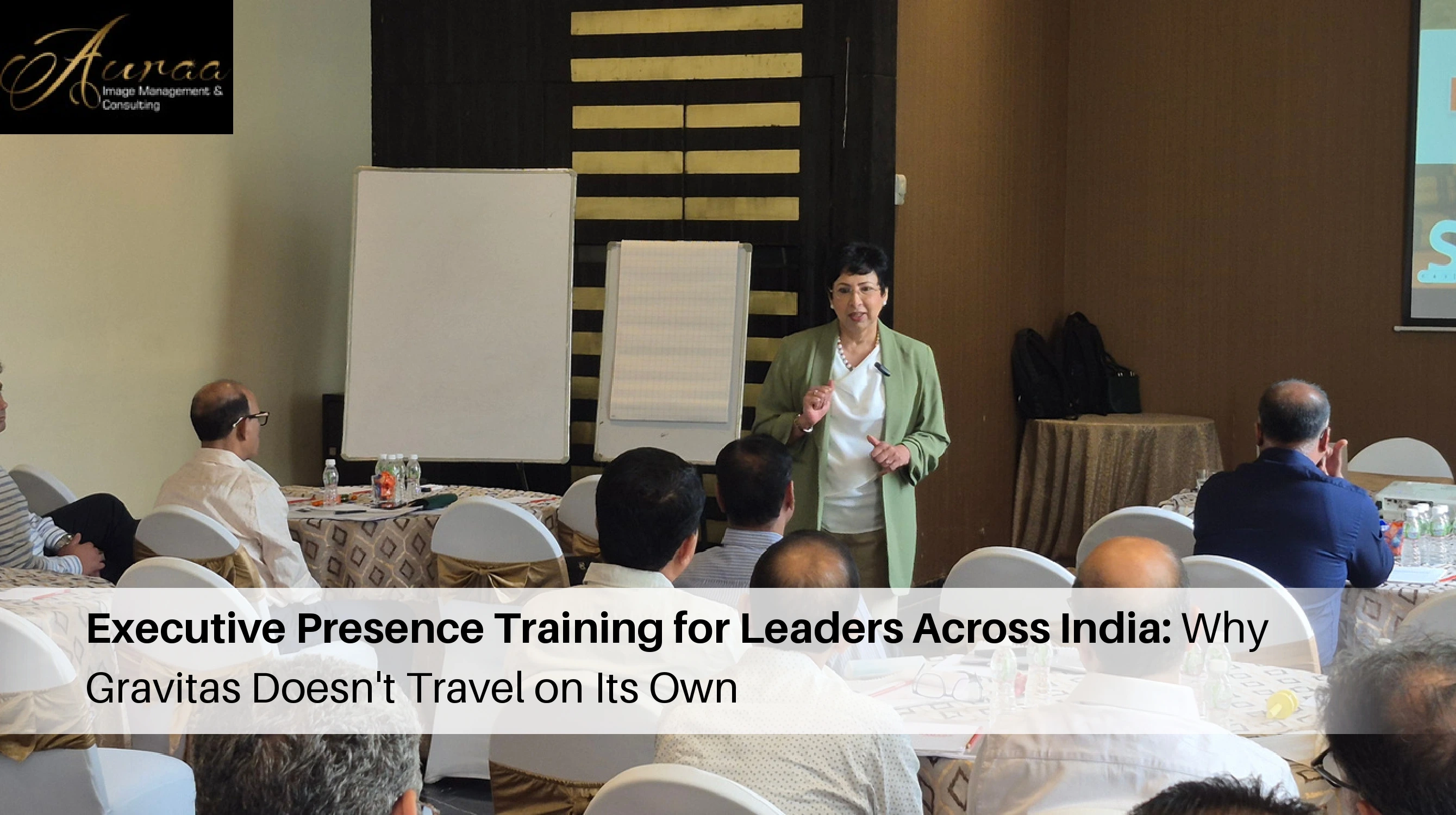
"Presence is the difference between a good idea and a followed idea." — Coach Samira Gupta
Companies with leadership teams spread across multiple cities are running into a costly, often invisible gap: a regional head who commands a Mumbai boardroom on Monday can read as flat and hesitant on a Tuesday video call with colleagues based in three other cities. The strategy hasn't changed. The presence has - and in organisations where leadership pipelines routinely span metros, that gap is becoming a genuine business problem, not one leader's personal quirk.
If your leadership team is based mainly in one office, our single-city Executive Presence program (Gurugram) goes deeper on in-person coaching for that specific office.
A National Leadership Gap, Not a City One
India's leadership pipelines increasingly manage people they've never met in person. A regional head in Chennai reports to a VP based in Gurugram, who presents to a board that includes members dialling in from Bengaluru and Singapore. Executive Presence built for a single room doesn't automatically hold up across that many contexts, and most leadership development programs were never designed with this reality in mind.
This matters more than it sounds. Decisions about who gets stretch assignments, who represents the company externally, and who gets fast-tracked are still made largely on impression, even in data-driven organisations. A leader whose presence doesn't carry across formats is quietly competing at a disadvantage against peers who've learned to project the same authority everywhere.
What Executive Presence Actually Means
Executive Presence researcher Sylvia Ann Hewlett frames it as gravitas, communication skill, and appearance working together, with her survey research finding that senior executives weight gravitas far above the other two factors. In a distributed, camera-first environment, all three get harder: gravitas has to register through a screen instead of a room's natural energy, communication has to hold attention without the benefit of physical proximity, and appearance now includes lighting, framing, and background, not just what someone is wearing. See Hewlett's "The New Rules of Executive Presence," Harvard Business Review for her full framework.
Where This Shows Up Most
- Leaders who are commanding in person but flat and hesitant on video calls, often without realising it
- Ideas that get lost in a multi-city call because a quieter voice couldn't cut through, regardless of the idea's quality
- Newly promoted managers leading teams they've inherited across cities, with no in-person track record to lean on
- Senior leaders whose written communication doesn't carry the same authority as their in-person presence, creating an inconsistent impression across touchpoints
Each of these gaps is fixable, but only once it's named. Most leaders have never been told, specifically, that their video presence reads differently from their in-person presence - they simply notice, over time, that certain rooms respond to them and certain calls don't, without understanding why.
The Core Components This Training Targets
Gravitas under pressure - handling disagreement and high-stakes moments without losing composure, whether that moment happens across a table or across a screen. Communication that commands attention on camera and in person, with attention to pacing, brevity, and cutting unnecessary hedging language. Physical and vocal presence adapted to hybrid formats, since posture and tone read differently on video than they do in a room. And strategic visibility - making sure the right stakeholders see a leader's contribution even when they're rarely in the same physical space.
The Business Case for a National Presence Standard
The cost of this gap rarely shows up on a P&L line, which is exactly why it persists. A capable regional leader gets passed over for a national role not because their strategy was weaker, but because the panel remembered a more confident-sounding peer from a different city. A strong idea gets attributed to whoever presented it most persuasively on a video call, regardless of who actually originated it. None of this gets tracked, but all of it shapes who gets promoted, who gets client-facing exposure, and whose voice carries weight in cross-functional decisions.
This is compounded by a wider trend: Gallup's State of the Global Workplace research has tracked a sharp fall in manager engagement across South Asia as teams become more distributed, which makes deliberately built presence, rather than presence that relies on proximity, more important for Indian leaders than ever. Organisations that treat Executive Presence as a national capability, rather than something individual leaders sort out for themselves, tend to see faster, more consistent promotion pipelines across offices.
Leaders coming up through Chennai, Pune, or Kolkata offices get evaluated on the same footing as those based in Gurugram or Mumbai, simply because presence has been deliberately built rather than left to whichever office happened to give someone more in-person exposure early in their career.
How This Plays Out Across Common Leadership Contexts
The specific presence challenge changes depending on the setting a leader operates in most:
| Context | Common Presence Gap | What Training Targets |
| Fully in-person leadership | Strong in the room, but no deliberate strategy for scaling that presence beyond it | Consistency, so presence isn't accidental |
| Hybrid leadership teams | Reads differently on video than in person, often unknowingly | Camera presence, framing, and vocal delivery |
| Fully remote or distributed teams | Struggles to build authority without in-person track record | Written and verbal communication that substitutes for physical presence |
| Client-facing / board-facing roles | Prepares content thoroughly but under-prepares delivery | Gravitas under pressure and structured executive communication |
None of these contexts are mutually exclusive - most leaders in India today move through two or three of them within the same week. Training is most effective when it treats presence as one adaptable skill applied across contexts, rather than teaching a single fixed style that only works in the setting where a leader happens to feel most comfortable.
FAQs
1. Does Executive Presence training work for fully remote leaders?
Yes. Video-based review and coaching are core parts of the training, since camera presence is now as important as in-room presence for most leadership roles in India's distributed workplaces.
2. Who should prioritise this training first?
Leaders managing teams across more than one city or time zone see the fastest, most visible returns, since the gap between their in-person and remote presence tends to be widest.
3. How is this measured?
Through video review, 360-degree feedback gathered from distributed team members, and observed performance in simulated high-stakes calls and meetings.
4. Can this be delivered to leadership cohorts spread across multiple cities?
Yes. Sessions can run in a hybrid format with an in-person cohort in one city and remote participants joining live from others.
5. Should a leader take this program or the city-based Executive Presence track - what's the actual difference?
Take this one if your team, board, or client relationships span more than one city or time zone; the city-based track goes deeper on a single office's specific dynamics and in-person coaching.
6. How long before a leader notices a difference in how they're received?
Many leaders report a shift in how meetings and calls land within the first few sessions, though sustained presence across formats develops over a full coaching cycle.
7. Does this training address written communication as well as spoken presence?
Yes. For distributed leaders, written communication often carries as much weight as spoken presence, so email and messaging tone are included.
8. Is this suitable for leaders who are strong technically but new to people leadership?
Yes, and this group often benefits the most, since presence gaps are usually most visible in someone's first year leading a team rather than later once habits have set in.
9. Does the training account for leaders who are naturally reserved or introverted?
Yes. The goal isn't to make every leader equally extroverted, but to help each person project the gravitas and clarity that fits their own natural communication style, on camera and in person.
Ready to Help Your Leaders Command the Room - In Person or on Screen?
Presence shouldn't depend on whether your leaders are in the building or on a call. Auraa Image Management & Consulting (AIM&C) offers expert-led Executive Presence Training for leadership teams across India, built specifically for organisations operating across multiple cities and formats.
Get in touch today to customize a training program for your team.
📞 Call: +91 9958934766 📧 Email: samira@auraaimage.com 🌐 Website: www.auraaimage.com