
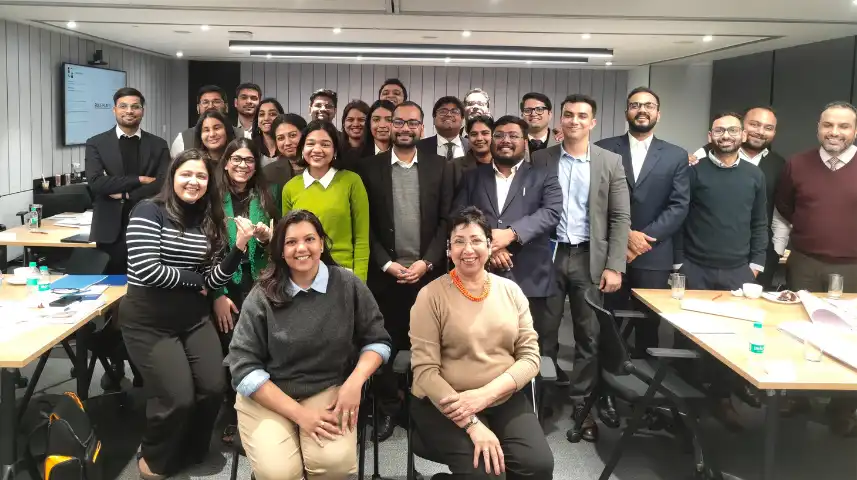
Leadership development programs focus on building strategic thinking, executive communication, emotional intelligence, and influence. Unlike basic management training, they strengthen executive presence helping leaders command credibility, build trust, and drive long-term business impact through poise, power, and performance.
Introduction: Leadership Is No Longer About Authority
“Leadership is not about being in charge. It is about taking care of those in your charge.” - Simon Sinek
For decades, leadership was equated with hierarchy. Title meant power. Seniority meant respect.
But today, authority does not guarantee influence.
In boardrooms, investor meetings, town halls, and high-stakes negotiations, what truly differentiates impactful leaders is not their designation—it is their executive presence.
Leadership development programs must therefore evolve. They must go beyond “how to manage a team” and instead focus on:
- Strategic clarity
- Emotional regulation
- Gravitas under pressure
- Executive communication
- Inner authority
Because long-term leadership success is not built on control.
It is built on credibility.
What Are Leadership Skills in the Executive Context?
Leadership skills are often defined as the abilities that enable someone to guide, motivate, and influence others toward achieving goals.
But at the executive level, leadership skills take on a deeper dimension.
They include:
- The ability to think long-term while acting decisively
- The capacity to regulate emotions under pressure
- The power to communicate complexity with simplicity
- The courage to take unpopular but strategic decisions
- The maturity to build trust across functions
Leadership Skills Definition (Executive Level)
Leadership skills are the strategic, interpersonal, and communication capabilities that enable leaders to influence outcomes, inspire confidence, and create sustainable impact.
Notice the word influence.
Influence—not instruction—is the currency of senior leadership.
Leadership vs Management: The Critical Distinction
Many professionals confuse leadership and management skills.
Management Focus
- Execution
- Process
- Control
- Efficiency
Leadership Focus
- Vision
- Direction
- Influence
- Culture
Managers optimize systems.
Leaders elevate people.
A strong leadership development program must help managers transition into leaders by strengthening:
- Strategic thinking
- Emotional intelligence
- Presence in high-stakes environments
- Communication clarity
Because technical competence may earn you a promotion.
Executive presence earns you trust.
Why Leadership Soft Skills Matter More Than Ever
At senior levels, technical expertise is assumed. No one becomes a director or CXO without strong domain knowledge. What truly differentiates leaders at the top, however, are their leadership soft skills.
These include:
- Listening deeply
- Empathy and social awareness
- Assertiveness
- Conflict navigation
- Strategic communication
- Adaptability
- Self-awareness
These skills create what I call “the polish premium.”
Two leaders may have equal competence.
But the one who:
- Speaks with clarity
- Listens deeply
- Responds calmly
- Carries composure
- Aligns body language with message
Will always command greater influence.
Soft skills are not soft.
They are power skills.
The Importance of Leadership Skills for Long-Term Success
Why are leadership skills non-negotiable today?
Because organizations are navigating:
- Rapid technological shifts
- Multi-generational workforces
- Global teams
- Market volatility
- Constant disruption
In such environments, leaders must:
- Stay calm under uncertainty
- Inspire confidence amid ambiguity
- Build cross-functional trust
- Make decisions with incomplete data
- Communicate vision repeatedly and convincingly
Without strong leadership communication skills, even the best strategy fails.
People do not follow strategy documents.
They follow conviction.
The 5 Core Leadership Skill Sets That Build Executive Presence
From my two decades of corporate leadership and a decade of coaching senior professionals, I see five foundational leadership skill categories:
1. Strategic Thinking Skills
- Seeing patterns beyond data
- Anticipating risks
- Connecting micro to macro
- Long-term orientation
2. Leadership Communication Skills
- Structured articulation
- Executive storytelling
- Handling Q&A confidently
- Persuasive clarity
3. Emotional Intelligence
- Self-regulation
- Empathy
- Social awareness
- Measured responses under pressure
4. Influence & Relationship Building
- Stakeholder mapping
- Managing upward
- Navigating politics gracefully
- Building credibility across functions
5. Personal Brand & Executive Presence
- Appearance alignment
- Vocal authority
- Body language congruence
- Gravitas
This is where leadership development programs must evolve toward integrated development.
What Makes a High-Impact Leadership Development Program?
Not all leadership development programs create transformation. High-impact programs operate on three levels:
1. Inner Clarity (Poise)
- Values alignment
- Self-awareness
- Emotional discipline
2. Strategic Authority (Power)
- Decision-making confidence
- Strategic positioning
- Influence mastery
3. Visible Impact (Performance)
- Communication precision
- Executive presence refinement
- Real-world simulations
True development integrates mindset, skill, and behavioural refinement.
Long-Term Success Is Built on Inner Authority
True leadership is not loud. It is centered.
Long-term success requires leaders to:
- Know their values
- Regulate ego
- Detach from validation
- Speak with conviction
- Listen without defensiveness
This inner authority builds external authority.
Without it, leadership becomes reactive.
With it, leadership becomes transformational.
Also Read: How exactly does a leadership Training Program work for you?
Final Thoughts: Leadership Is a Lifelong Evolution
Leadership development is not a one-time workshop. It is a continuous refinement of how you think, communicate, show up, and influence others.
In today’s competitive and fast-evolving business landscape, technical competence is merely the baseline.
Executive presence is the true differentiator.
Sustainable leadership success is built on strategic clarity, emotional maturity, and the ability to inspire confidence in moments that matter most.
If you are a senior leader ready to:
- Elevate your strategic influence
- Strengthen executive communication
- Build gravitas in high-stakes environments
- Position yourself for CXO-level growth
Explore bespoke 1:1 Executive Presence Coaching and curated Leadership Development Programs designed for senior leaders at: www.samiragupta.com
Frequently Asked Questions
Q. What are leadership development programs?
Ans. Leadership development programs are structured training initiatives designed to strengthen strategic thinking, communication, emotional intelligence, and decision making. They help professionals move beyond operational management and build the influence, credibility, and executive presence required to lead teams, shape strategy, and drive long term organizational success.
Q. How are leadership development programs different from management training?
Ans. Management training focuses on operational efficiency, processes, and team supervision. Leadership development programs go deeper by strengthening strategic thinking, influence, emotional intelligence, and executive communication. They help professionals transition from managing tasks to guiding vision, building trust, and shaping organizational direction.
Q. Why is executive presence important for senior leaders?
Ans. Executive presence builds credibility, trust, and confidence in leadership. It enables leaders to communicate clearly, remain composed under pressure, and influence high stakes decisions. In boardrooms and strategic discussions, executive presence often determines whether ideas are accepted, trusted, and acted upon.
Q. What skills are developed in executive leadership development programs?
Ans. Executive leadership programs develop strategic thinking, leadership communication, emotional intelligence, stakeholder influence, and executive presence. Participants also strengthen decision making, conflict navigation, and personal leadership brand, helping them lead with clarity, confidence, and credibility in complex organizational environments.
Q. Who should enroll in leadership development programs?
Ans. Leadership development programs are ideal for senior managers, emerging leaders, directors, and executives preparing for CXO roles. Professionals responsible for strategic decisions, cross functional leadership, or organizational influence benefit the most from structured leadership capability development.
Q. How long does it take to build executive presence?
Ans. Building executive presence is a gradual process that typically develops over several months of focused practice and feedback. Through coaching, real world simulations, and communication training, leaders refine their mindset, behavior, and communication style to project confidence, credibility, and authority consistently.
Q. Do leadership soft skills impact long-term business success?
Ans. Yes. Leadership soft skills such as emotional intelligence, communication, adaptability, and relationship building significantly impact long term business success. These skills help leaders build trust, manage uncertainty, inspire teams, and align stakeholders around strategy, ultimately improving organizational performance and decision making.
Q. What makes a leadership development program truly effective?
Ans. An effective leadership development program combines self awareness, behavioral feedback, strategic thinking development, and communication training. High impact programs include simulations, coaching, and practical leadership scenarios that help professionals apply new skills directly to real business challenges and leadership responsibilities.
Ready to shape your career story with confidence?
Call: +91 9958934766
Email: samira@auraaimage.com